
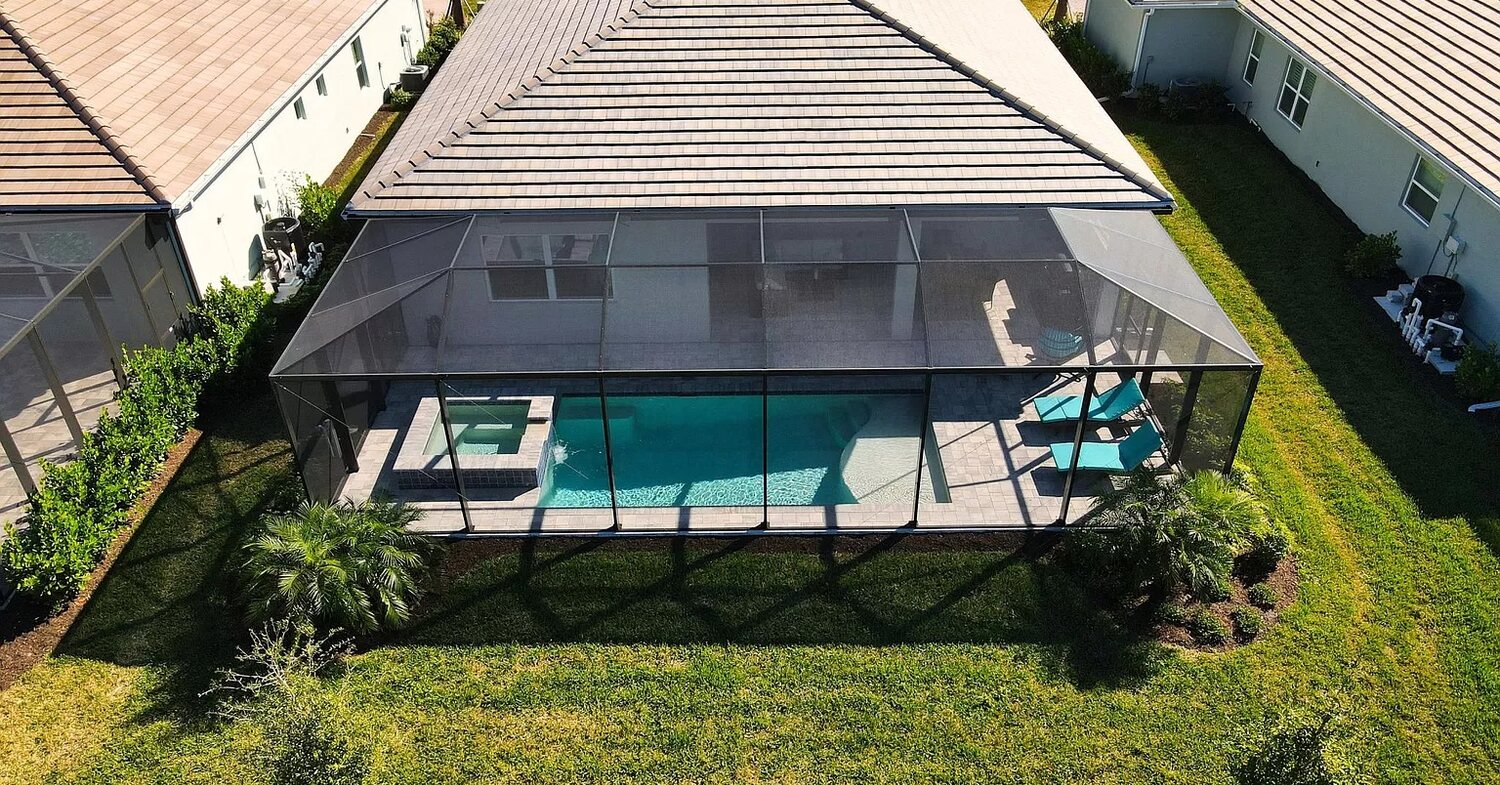
Hurricane-resistant pool screen enclosures in Florida are engineered assemblies, not catalog kits, and the difference shows the morning after a named storm. Frame alloy, anchor pattern, fastener metal and screen grade are all calculated against a design wind speed before a single post is set. Skip that math and the cage becomes a sail.
We build across Hillsborough, Polk and Manatee counties, and homeowners ask the same three questions every June. What wind speed does the code require? Which parts give way first? What does the permit really cost? Here are the answers, using the specifications we put on our own drawings for hurricane-resistant pool screen enclosures.
Quick answer: Hurricane-resistant pool screen enclosures are designed to a minimum 130 mph wind speed under the 8th Edition (2023) Florida Building Code, effective 31 December 2023, which references ASCE 7-22 for wind loads. Expect a 6005-T5 aluminum frame, stainless or ceramic coated fasteners, 18/14 mesh, engineered drawings at $200 to $600, and a permit package of $350 to $1,350.
Table of Contents
How Florida Building Code Shapes Hurricane-Resistant Pool Screen Enclosures
The rulebook is the 8th Edition (2023) of the Florida Building Code, effective 31 December 2023. It points to ASCE 7-22 for wind load calculation, and for screen enclosures across our service area the minimum design wind speed is 130 mph. That one number drives column size, beam depth, anchor spacing and how much open mesh a single panel may carry.
Hillsborough, Polk and Manatee counties are not in the High Velocity Hurricane Zone, which covers Miami-Dade and Broward only. Engineering here still meets the same code and still needs stamped drawings, so no homeowner in Tampa or Lakeland should pay an HVHZ surcharge. The Aluminum Association of Florida publishes the aluminum construction guidance our industry uses, and anyone quoting hurricane-resistant pool screen enclosures should hand you the signed plan set.
Frame Alloy and Spans on Hurricane-Resistant Pool Screen Enclosures
Pool cage extrusions are typically 6005-T5 aluminum, an alloy picked for strength and corrosion behavior around chlorinated water. Wall thickness and profile size climb as spans grow, so a 40 foot clear run needs heavier beams and tighter upright spacing than a 16 foot run against the house. A wind rated pool cage Florida engineers will stamp is sized panel by panel, never by rule of thumb.
Frames last a long time when the spec is right. Inland Hillsborough County frames commonly run 25 to 30 years, while coastal exposure near Palmetto and Ellenton shortens that to 20 to 25 years as salt attacks every joint. Get upright spacing in writing before comparing bids on hurricane-resistant pool screen enclosures, because a wind rated pool cage Florida inspectors approve is priced by its engineering, not by square footage alone.
Anchors and Fasteners: Where Florida Pool Cages Fail First
Every hurricane screen enclosure lives or dies at its connections. Wind does not push a cage over so much as lift it, and the anchors carry that uplift into the deck or footer. When a cage peels away in a storm, the frame is often intact while the base plates hang from a cracked slab edge.
- Anchors set with proper edge distance into sound concrete
- Stainless or ceramic coated screws, since plain steel bleeds rust in months
- No dissimilar metals at a joint, which invites galvanic corrosion
- Base plates and columns tied to the structural slab or a poured footer
- Hardware re-checked after any rainfall of 1.5 inches or more
Hardware is a small line on the invoice and the biggest share of the risk on hurricane-resistant pool screen enclosures, so we specify it first.
Screen Mesh and Wind Pressure on Florida Pool Cages
There is no such thing as a storm proof pool enclosure, and any contractor using that phrase is selling rather than explaining. Hurricane-resistant pool screen enclosures are built to let air pass through. Standard 18/14 charcoal fiberglass mesh is deliberately the weakest link, releasing under extreme pressure so the aluminum survives while the fabric gives way.
Grade matters more for lifespan than for strength. Fiberglass mesh runs 7 to 12 years, aluminum mesh 10 to 15 years, and vinyl coated pet screen 15 years or more, with only $0.10 to $0.40 per square foot between grades. Our guide to pool enclosure screen types compares them panel by panel. A true storm proof pool enclosure would need solid walls, which is a different structure carrying entirely different loads and a much larger permit package.
Roof Shapes for Hurricane-Resistant Pool Screen Enclosures
Roof geometry changes both the wind load and the price. A mansard roof, with its sloped perimeter and flat center, is the most economical shape and the one we install most often. A gable roof raises the peak for headroom and an open feel, and it costs more because taller columns and longer beams carry higher loads.
A dome roof sits at the premium end, curving the frame over larger decks. Height is the trade-off: the taller the structure, the greater the pressure engineering has to resolve, which pushes beam sizes and anchor counts up on hurricane-resistant pool screen enclosures. Homeowners weighing why these structures exist at all usually start with our explainer on why Florida pools have cages.
| Component | Minimum acceptable | What a well built job uses |
|---|---|---|
| Frame | 6005-T5 aluminum sized to 130 mph | Span by span engineering on stamped plans |
| Anchoring | Anchors into sound concrete | Base plates tied to slab or poured footer |
| Fasteners | Corrosion resistant hardware | Stainless or ceramic coated, no mixed metals |
| Mesh | 18/14 fiberglass, 7 to 12 years | Aluminum mesh, 10 to 15 years |
| Roof | Mansard with engineered beams | Mansard, gable or dome, calculated for height |
Want the spec for your deck instead of a range? Send the pool dimensions and a photo of the deck edge, and we will price hurricane-resistant pool screen enclosures properly. Call (813) 777-5665 for a free quote inside 12 to 24 hours.
Permits, Inspections and Cost Across Hillsborough County
Every hurricane screen enclosure needs a permit and an engineering review for wind load. Budget $200 to $600 for engineered drawings, $150 to $400 for the permit fee, $50 to $100 for inspections, and $100 to $250 more to expedite, putting the package at $350 to $1,350. Building without one risks a fine of $500 to $1,000 per day.
Plans take 3 to 7 days and county review runs 10 to 20 business days, so the whole path spans 5 to 8 weeks. Two inspections are mandatory, framing and final, each booked 24 to 48 hours ahead. Construction takes 3 to 5 business days once the permit clears. Hurricane-resistant pool screen enclosures run $12 to $20 per square foot of covered deck, so 800 square feet lands at $10,000 to $16,000. Our pool screen enclosure cost guide breaks down each line.
Ready to put a number on it? We cover Tampa, Brandon, Riverview, Valrico, Lakeland, Palmetto and the rest of Hillsborough, Polk and Manatee counties in Florida. Quotes on hurricane-resistant pool screen enclosures are free. Reach us through our contact page.
Frequently Asked Questions
What wind speed must a pool screen enclosure be designed for?
The minimum design wind speed for screen enclosures is 130 mph. The 8th Edition (2023) Florida Building Code, effective 31 December 2023, references ASCE 7-22 for wind loads, and an engineer applies them to the frame, span and height of each structure.
Does a pool cage need a permit and inspections?
Yes. Every hurricane screen enclosure requires a permit plus engineering review for wind load, followed by two mandatory inspections, framing and final, booked 24 to 48 hours ahead. Building without a permit carries a penalty of $500 to $1,000 per day.
Why does the screen tear before the aluminum frame bends?
That behavior is deliberate. Mesh is the sacrificial element in hurricane-resistant pool screen enclosures, releasing under extreme pressure so wind passes through instead of loading the structure. Replacing 18/14 mesh costs far less than rebuilding bent beams or resetting anchors.
Which aluminum alloy is used for pool cage framing?
Most Florida pool cages use 6005-T5 aluminum extrusions, chosen for strength and corrosion resistance near chlorinated water. Inland frames commonly last 25 to 30 years, while coastal exposure shortens that to 20 to 25 years as salt air attacks fasteners and joints.
How quickly should storm damage to a screen enclosure be repaired?
Aim to finish post-storm repairs within 30 to 60 days. A torn panel lets rain reach framing and hardware, and a loose anchor left through the next storm turns a modest repair into structural work. Inspect after rainfall of 1.5 inches.
Building Hurricane-Resistant Pool Screen Enclosures That Hold
All of it reduces to one habit: get the specification in writing and confirm it matches the stamped drawings. Alloy, anchor spacing, fastener metal, mesh grade and roof shape are the five items to read before signing. A quote listing only square footage and a price is a guess dressed up as a bid for hurricane-resistant pool screen enclosures.
Affordable Lanai holds Florida contractor license SCC131153480, with 15 years in this trade and more than 1,000 projects completed across our service area. We back installations with a 10-year warranty on materials and a 1-year warranty on labor, quote free within 12 to 24 hours, and offer financing through HFS. Details sit on our pool screen enclosure page.
Let’s design yours. Call (813) 777-5665 or email [email protected], and we will measure the deck, confirm the permit path and quote hurricane-resistant pool screen enclosures built to the wind load your address requires.