
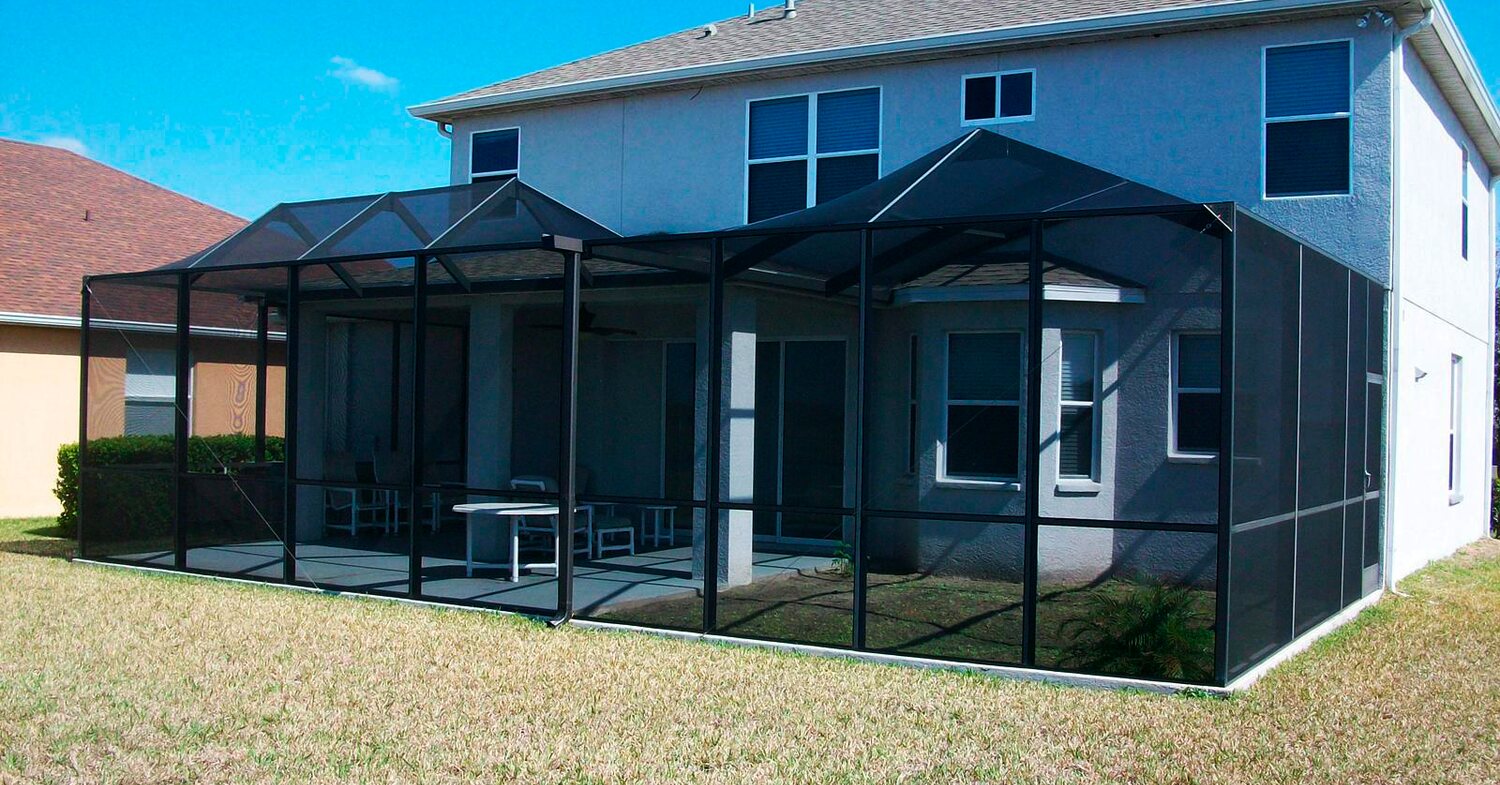
Florida storm damage lanai screen repairs spike between June 1 and November 30, and homes across Tampa and Brandon report the same short list of failures: torn mesh, spline pushed from its groove, a bent frame member and a lifted anchor. That is nearly every call we take once the wind drops.
Most of it is preventable. An enclosure engineered to a 130 mph design wind speed, anchored correctly and checked twice yearly rides out an ordinary season with nothing worse than leaf litter. This guide covers the warning signs and the Florida storm damage lanai screen repair timeline that keeps tears small.
Quick answer: Nearly every Florida storm damage lanai screen problem starts small. Before June 1, clear furniture and planters, tighten every ceramic or stainless fastener, re-spline loose mesh and check anchors. After a storm, book repairs inside 30 to 60 days.
Table of Contents
What Storm Damage Actually Looks Like on a Lanai Screen
Wind rarely takes an enclosure down at once. It finds the driest spline, the loosest fastener or the panel nobody anchored properly, and works there until something gives. The order almost never changes. Four failures cover almost every Florida storm damage lanai screen call: mesh torn along a seam, spline lifted from its groove, a bent frame member, and an anchor pulled off the slab.
Torn mesh reads as cosmetic right up until it is not. A loose panel tugs the spline beside it, that spline releases, and the load transfers onto aluminum never meant to carry it. Anchors are the quiet failure, since a lifted plate hides behind a planter for months. Walk the perimeter after any rainfall of 1.5 inches or more, because those afternoon cells carry the gusts that start most Florida storm damage lanai screen problems.
Your Seven Step Storm Prep Lanai Checklist for Hillsborough County
Run this list in late May and again in early August. None of it needs special tools, a careful homeowner finishes the pass in one afternoon, and steady upkeep extends usable screen life by 40% to 60%.
- Wash the mesh with a 1 to 4 vinegar and water mix, never a pressure washer above 1,200 PSI.
- Check every ceramic or stainless steel fastener and replace anything showing red rust.
- Press each panel and re-spline any section that ripples.
- Confirm the base anchors sit flush and no plate has lifted.
- Clear the gutter line and deck drains.
- Trim branches back at least 6 feet from the frame.
- Patch tears under 2 inches with a $15 kit, about 20 minutes.
Our lanai screen maintenance guide for Florida homes covers each step, and the routine is the cheapest storm insurance a lanai ever gets.
Why a Wind Resistant Screen Enclosure Survives Florida Storms
Two enclosures on the same street can meet identical gusts and finish the season differently. The one still standing was engineered, permitted and inspected. Every lanai enclosure in Florida requires a permit and a wind load review, and the minimum design wind speed for these structures is 130 mph.
Specification decides the outcome. A wind resistant screen enclosure uses 6005-T5 aluminum alloy for the frame, ceramic coated or stainless steel fasteners that will not bleed rust into the extrusion, and anchors sized for the slab beneath. Framing and final inspections confirm the build matches the drawings.
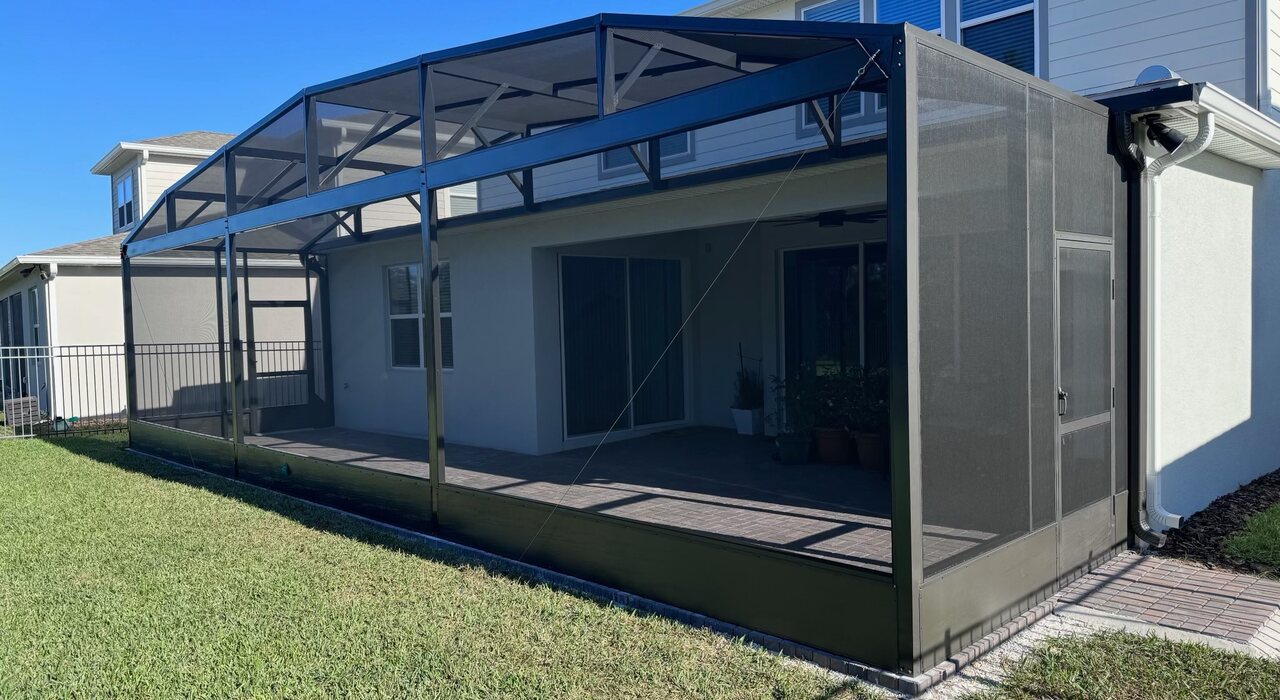
Cheap work skips those parts. Undersized fasteners, thin uprights and anchors set too near a slab edge sit behind most Florida storm damage lanai screen failures. Our lanai screen enclosure page shows how a hurricane screen enclosure Florida homeowners can trust is put together.
The 48 Hours Before a Named Storm Reaches Tampa
Once a system has a name and a cone, your storm prep lanai work shifts from maintenance to clearing the box. A screen enclosure is built to let wind pass through the mesh. Anything solid inside becomes a sail or a projectile, and that is what tears panels off their splines.
Move patio furniture, grills, planters, hanging baskets and umbrellas into the garage or indoors. Unclip any privacy panel, shade cloth or solar screen, because a solid surface loads the frame in a way the engineering never assumed. Photograph all four elevations for the insurance file. The Florida Division of Emergency Management preparedness guidance covers the household side of those 48 hours.
Leave the mesh alone otherwise. Taping, boarding or wrapping screen does not help, and the added pressure often causes the very tears the effort was meant to prevent.
Florida Storm Damage Lanai Screen Repair Timelines and Costs
Book Florida storm damage lanai screen repairs inside 30 to 60 days. Carriers expect prompt notice, and an open tear works on the panels beside it every day it stays open.
Scale sets the price. A single rescreened panel is a small job. A frame member bent at the beam is structural, needs the correct extrusion and a permit. New enclosures run $30 to $55 per square foot, so a 20×20 rebuild lands near $13,380 with 2 to 3 days on site. Annual upkeep of $150 to $400 costs far less than one Florida storm damage lanai screen rebuild.
Age matters too. If the mesh is already 10 to 12 years old, rescreening the whole enclosure usually beats patching panel by panel, and our guide to how long a lanai screen enclosure lasts in Florida shows where that line sits.
| Damage | Action | Urgency |
|---|---|---|
| Torn mesh under 2 inches | Patch kit under $15, 20 minutes | Within 7 days |
| Loose or displaced spline | Re-spline with a spline roller | Within 14 days |
| Bent frame member | Contractor swaps the 6005-T5 extrusion | Within 30 days |
| Anchor lifted off slab | Stop using it, book a structural inspection | Within 3 days |
Which row are you in? Send three photos and we will say whether it is a patch, a rescreen or frame repair. We cover Tampa, Brandon and the rest of Hillsborough, Polk and Manatee counties, and the review is free.
Screen Grades That Hold Up Through Florida Hurricane Season
Mesh fails first, and the grade you choose changes how often. Standard fiberglass lasts 7 to 12 years, aluminum mesh runs 10 to 15 years, and vinyl coated polyester pet screen commonly passes 15 years. No-see-um and solar meshes sit between 10 and 18 years depending on grade.
The upgrade is close to free. Moving between grades costs roughly $0.10 to $0.40 per square foot, so stronger mesh on a hurricane screen enclosure Florida weather will test adds little while removing several rescreens across the frame’s 25 to 30 year life. Standard 18/14 charcoal fiberglass remains the default here, with 18×16 aluminum mesh as the tougher option.
Our comparison of aluminum versus fiberglass screen in Florida sets out visibility, airflow and cost side by side, and grade is one decision you only make once a decade.
Ready to get the enclosure storm ready? A pre-season inspection beats an emergency call in September, and quotes are free. Reach us through our contact page or call (813) 777-5665, and we will say whether your Florida storm damage lanai screen risk is a spline issue or structural.
Frequently Asked Questions
Does a screen enclosure need a permit in Florida?
Yes. Every lanai enclosure in Florida requires a building permit and an engineering wind load review, with a minimum design wind speed of 130 mph. Two inspections are mandatory, framing and final, and permits run $350 to $1,350.
How soon should storm damage be repaired?
Within 30 to 60 days. Insurers expect notice, and an open tear keeps loading the panels and splines beside it. A Florida storm damage lanai screen tear left through a second storm often turns a rescreen into frame replacement.
Should screens be removed before a hurricane?
No. Mesh is designed to let wind pass through, and removing it leaves the frame carrying loads without the panel bracing it. Remove furniture, planters, grills and any privacy or shade panel instead, since those act as sails.
What wind speed is a screen enclosure built for?
A wind resistant screen enclosure in Florida starts at a 130 mph design wind speed, the exact figure set by site. Frames use 6005-T5 aluminum alloy with ceramic coated or stainless steel fasteners so connections do not corrode.
When should an enclosure be inspected in hurricane season?
Hurricane season runs June 1 to November 30. Inspect after any rainfall of 1.5 inches or more and after every named storm, checking mesh tension, spline seating and anchors. Catching a Florida storm damage lanai screen issue early keeps repairs small.
Getting Ahead of Florida Storm Damage Lanai Screen Risk
Storms are not the variable you control. The specification, the anchoring and the twice yearly walk around are. Homeowners who run the checklist, patch tears the same week and clear the box spend less on Florida storm damage lanai screen work over 25 to 30 years.
We have built and repaired enclosures for more than 15 years, with more than 1,000 projects completed under Florida license SCC131153480. Our work carries a 10-year warranty on materials and a 1-year warranty on labor, quotes are free, usually back within 12 to 24 hours, and HFS financing is available.
Let’s get you ready before June 1. Call (813) 777-5665 or email [email protected] and we will check the frame, mesh and anchors and hand you a written storm plan for the enclosure.