
When it comes to building a patio in Tampa Bay, the material you choose sets the tone for everything else. Two options consistently rise to the top of every homeowner’s shortlist in the travertine vs concrete pavers tampa conversation. Both materials bring real advantages to the table, but they perform very differently under Florida’s sun, rain, and humidity. Understanding those differences before you commit can save you thousands of dollars and years of frustration.
The travertine vs concrete pavers tampa debate is one we hear nearly every week from homeowners planning their next outdoor project.
This guide breaks down the travertine vs concrete pavers tampa homeowners ask about most often. We cover heat performance, durability, cost, maintenance, and overall value so you can choose with confidence. Whether you are planning a new paver patio, a pool deck, or a lanai floor, understanding the travertine vs concrete pavers tampa choice makes all the difference in how your outdoor space looks and feels for years to come.
Travertine pavers stay cooler underfoot in Florida heat, offer a natural stone look, and resist slipping when wet. Concrete pavers cost 30 to 50 percent less upfront, come in more colors and patterns, and require less specialized installation. For pool decks and barefoot areas, travertine is usually the better pick. For driveways, walkways, and budget-conscious patio projects, concrete pavers deliver excellent value. This travertine vs concrete pavers tampa comparison covers everything you need to decide.
Table of Contents
- What Are Travertine Pavers?
- What Are Concrete Pavers?
- Heat Performance in Tampa Bay’s Climate
- Durability and Lifespan Compared
- Cost Breakdown for Florida Patio Projects
- Slip Resistance and Safety Around Pools
- Maintenance Requirements in Florida
- Design Options and Aesthetic Appeal
- Which Paver Works Best for Pool Decks vs Patios?
- Choosing the Right Installer for Your Tampa Bay Patio
- Frequently Asked Questions
- Conclusion
What Are Travertine Pavers?
Travertine is a natural limestone formed over thousands of years by mineral deposits in hot springs and caves. It is quarried in large blocks and then cut into pavers of various sizes and thicknesses. The surface has a naturally textured, slightly porous appearance with subtle color variations ranging from ivory and cream to walnut and gold. No two travertine pavers look exactly alike, which gives any travertine vs concrete pavers tampa project a distinctive, high-end advantage when homeowners choose natural stone.
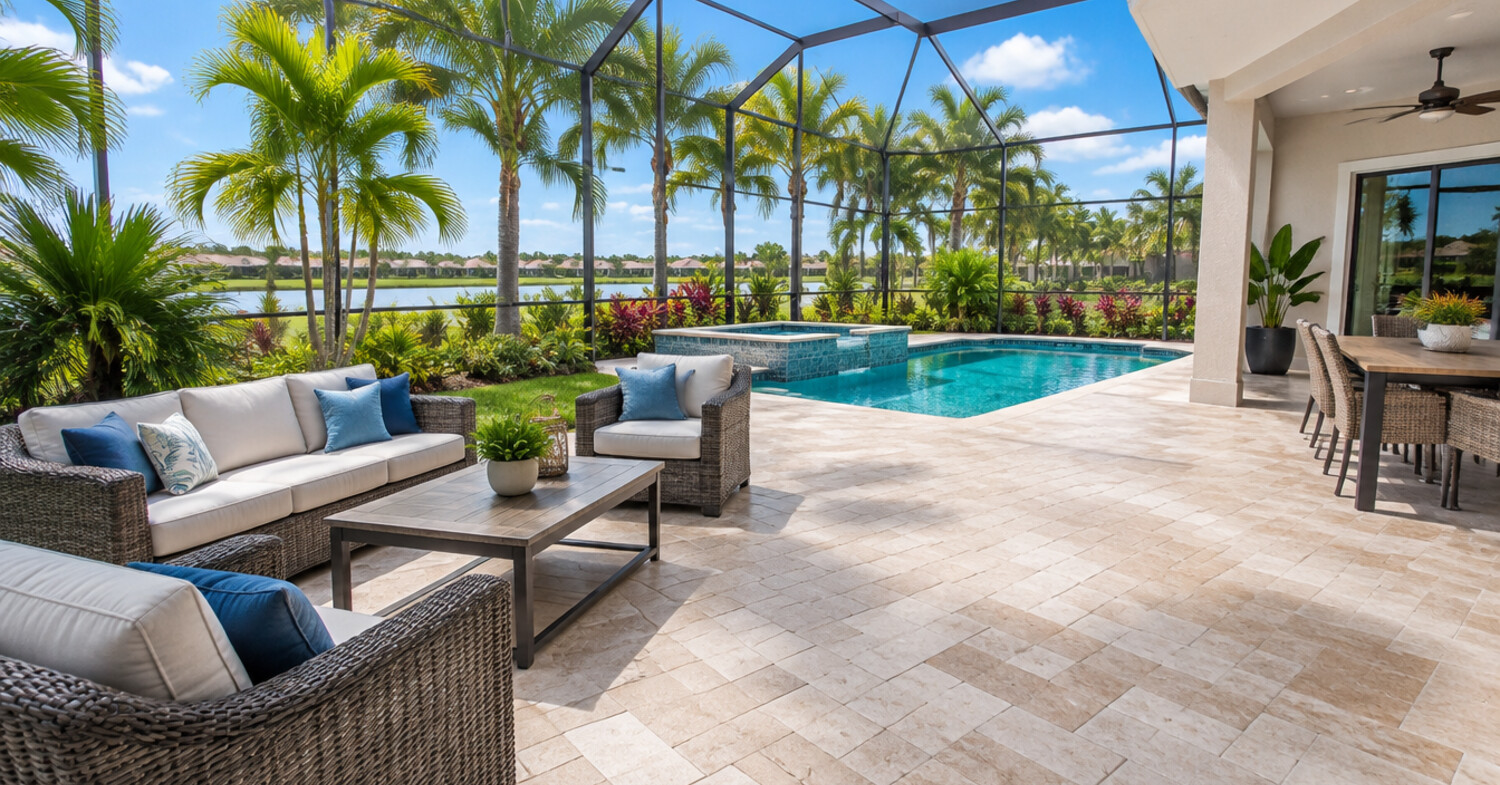
In Florida, travertine pavers have become especially popular for pool decks, lanai floors, and outdoor living areas. The stone’s natural density and composition allow it to reflect heat rather than absorb it, which keeps travertine pavers tampa installations noticeably cooler than most alternatives on hot summer days. This single characteristic is often the deciding factor in the travertine vs concrete pavers tampa debate for homeowners who spend a lot of time outdoors barefoot.
Travertine pavers are typically available in tumbled, honed, or brushed finishes. Tumbled travertine has rounded edges and a rustic texture that hides wear well. Honed travertine has a smooth, matte surface with a more refined look. Brushed travertine falls somewhere in between, offering texture without the rough edges. Each finish affects slip resistance, heat performance, and overall aesthetics differently in any travertine vs concrete pavers tampa installation.
What Are Concrete Pavers?
Concrete pavers are manufactured from a mixture of cement, sand, gravel, and pigments that are pressed into molds under high pressure and then cured. This manufacturing process allows for precise control over shape, size, color, and texture, which is a key factor in the travertine vs concrete pavers tampa decision. Concrete pavers come in an enormous range of styles, from simple rectangular bricks to interlocking patterns that mimic natural stone, cobblestone, or even wood planks.
When weighing travertine vs concrete pavers tampa homeowners often discover that concrete’s biggest advantage is versatility. Because they are manufactured rather than quarried, they can be produced in virtually any color, shape, or pattern a homeowner wants. This makes concrete pavers tampa bay homeowners choose ideal for creative patio designs, complex driveway layouts, and decorative walkways where specific colors need to match the home’s exterior.
Modern concrete pavers have come a long way from the basic gray blocks of decades past. Today’s premium concrete pavers feature advanced coloring techniques that extend deeper into the material, reducing the fading that older concrete products were known for. Some manufacturers also add polymeric coatings that improve stain resistance and help travertine vs concrete pavers tampa projects maintain their appearance longer in Florida’s intense UV environment.
Heat Performance in Tampa Bay’s Climate
Surface temperature is one of the most important factors for any outdoor flooring material in Tampa Bay. Summer temperatures routinely exceed 90 degrees, and surfaces in direct sunlight can reach 150 degrees or more. Walking barefoot on a scorching patio or pool deck is not just uncomfortable. It can actually cause burns, especially for children and pets, which makes the travertine vs concrete pavers tampa heat question critical.
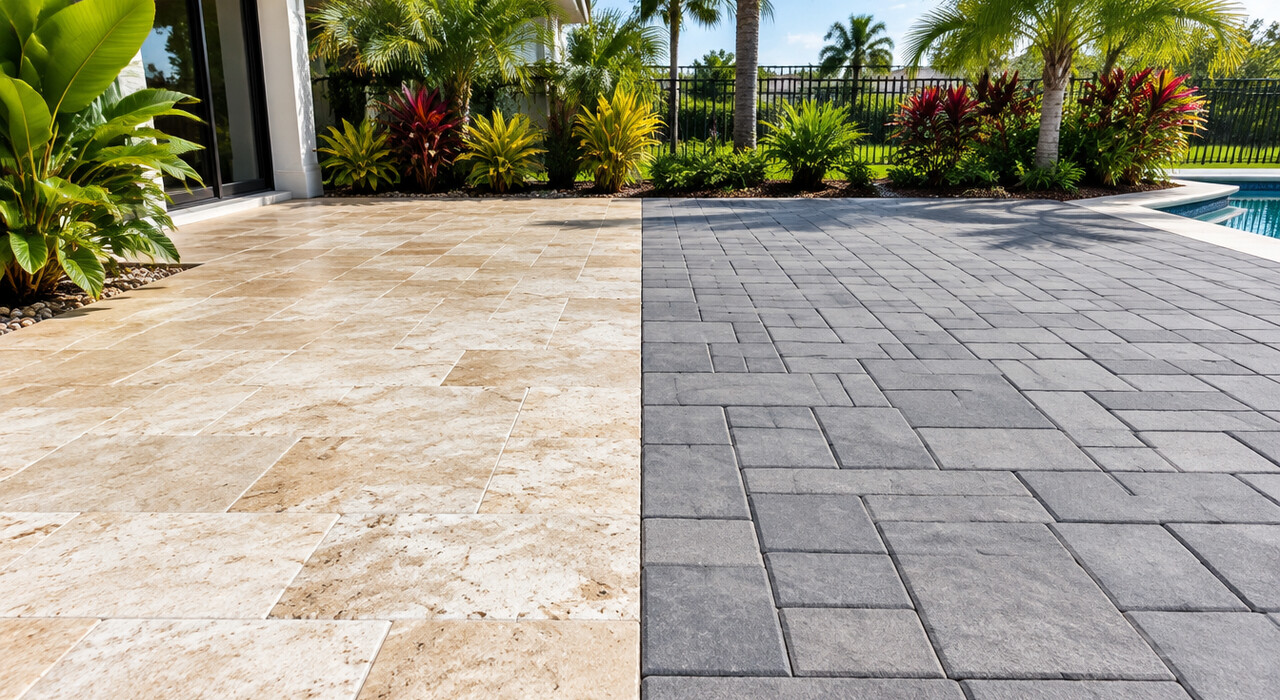
Travertine consistently outperforms concrete pavers in heat tests. Natural travertine reflects a significant portion of solar radiation rather than absorbing it, which keeps the surface 20 to 30 degrees cooler than standard concrete pavers under the same conditions. On a 95-degree day, a travertine pool deck might reach 110 to 115 degrees while a concrete paver deck could hit 135 to 145 degrees. That difference in the travertine vs concrete pavers tampa heat comparison is the line between comfortable and painful for bare feet.
Lighter-colored concrete pavers narrow the gap somewhat. A cream or sand-colored concrete paver will stay cooler than a dark charcoal one. However, even light concrete pavers tend to run 10 to 15 degrees warmer than travertine of a similar shade. The difference comes from the stone’s natural composition and porosity, which concrete manufacturing cannot fully replicate in any travertine vs concrete pavers tampa comparison. This is why travertine pavers tampa pool decks consistently outperform concrete in heat tests.
For homeowners planning a paver patio in Tampa Bay, heat performance should be a primary consideration, especially for areas adjacent to pools, spas, or lanai enclosures where people walk barefoot regularly.
Durability and Lifespan Compared
Both travertine and concrete pavers are durable enough for residential use in Florida, but they handle the elements differently over time. Travertine is a natural stone with a compressive strength that typically exceeds 2,500 PSI. High-quality concrete pavers rate between 8,000 and 10,000 PSI. On raw strength alone in the travertine vs concrete pavers tampa matchup, concrete pavers actually win this category by a wide margin.
However, strength is not the only factor in longevity. Concrete pavers are susceptible to color fading over time, especially in Florida’s intense UV environment. Even premium concrete pavers with integral coloring will show some fading within five to ten years. Travertine, being a natural stone, does not fade in the traditional sense. Its color is inherent to the mineral composition, so travertine pavers tampa homeowners install look the same in year fifteen as they did on installation day.
Both materials can crack under extreme stress, such as heavy vehicle traffic or ground settling. Travertine is slightly more brittle than concrete and can chip along the edges if hit with a hard object. In a travertine vs concrete pavers tampa durability test, concrete pavers are more flexible and absorb impacts better. In either travertine vs concrete pavers tampa scenario, individual damaged pavers can be replaced without disturbing the surrounding area, which is a significant advantage over poured concrete slabs.
With proper installation and basic maintenance, travertine pavers last 25 to 50 years or more. Concrete pavers typically last 20 to 30 years before the surface texture and color show enough wear to warrant replacement. Both lifespans are excellent for the investment, but in the travertine vs concrete pavers tampa longevity comparison, travertine edges ahead for homeowners who want a truly long-term solution.
Cost Breakdown for Florida Patio Projects
Cost is where concrete pavers have their clearest advantage. For a typical 400-square-foot tampa paver patio, here is what homeowners can expect to pay for materials and professional installation.
Concrete pavers generally run $8 to $15 per square foot installed, depending on the style, thickness, and complexity of the pattern. A straightforward running bond or herringbone layout with standard-grade concrete pavers tampa bay contractors install falls at the lower end. Premium interlocking pavers with complex patterns and enhanced coloring push toward the higher end. For a 400-square-foot patio, that translates to roughly $3,200 to $6,000 total.
Travertine pavers typically cost $15 to $30 per square foot installed. The wide range reflects differences in stone grade, thickness, finish, and origin. Imported travertine from Turkey or Mexico tends to cost less than premium Italian or Persian travertine. A 400-square-foot tampa paver patio using travertine generally runs $6,000 to $12,000 total, including base preparation and installation labor.
In any travertine vs concrete pavers tampa project, base preparation costs are similar for both materials. Florida’s sandy soil requires a proper compacted base of crushed limestone or shell, typically 4 to 6 inches deep, topped with a 1-inch layer of leveling sand. This base work adds $3 to $5 per square foot regardless of whether you choose travertine or concrete pavers on top.
When comparing travertine vs concrete pavers tampa project costs, remember to factor in long-term maintenance and replacement. Concrete pavers may need sealing every two to three years at $1 to $2 per square foot. Travertine sealing runs slightly higher at $1.50 to $3 per square foot but can be done less frequently, every three to five years in any travertine vs concrete pavers tampa project.
Slip Resistance and Safety Around Pools
Safety around water features is a non-negotiable consideration in the travertine vs concrete pavers tampa evaluation for any pool area project. Both travertine and concrete pavers can provide adequate slip resistance, but they achieve it differently.
Travertine pavers have a naturally textured surface, especially in tumbled and brushed finishes, that provides excellent grip when wet. The stone’s porous nature also helps by absorbing a thin layer of water rather than letting it sit on the surface where feet can hydroplane. This natural drainage characteristic is one reason travertine pavers tampa contractors recommend for commercial pool decks, resort areas, and waterparks across Florida.
Concrete pavers rely on their manufactured texture for slip resistance. Many concrete paver designs include intentional surface roughness or micro-texturing that provides good grip when wet. However, over time, foot traffic can polish the surface smooth, gradually reducing its slip resistance. Sealed concrete pavers tampa bay homeowners maintain can become particularly slippery when wet if a high-gloss sealer is used instead of a matte or non-slip formula.
According to the ANSI A326.3 standard for measuring wet dynamic coefficient of friction, both materials can meet or exceed the recommended minimum of 0.42 DCOF when properly finished. The key in any travertine vs concrete pavers tampa pool deck is choosing the right surface treatment and maintaining it correctly over time.
Maintenance Requirements in Florida
Florida’s climate creates specific maintenance challenges for any outdoor paving material. High humidity promotes mold and algae growth, frequent rain washes in organic debris, and intense UV breaks down sealers and surface treatments faster than in northern states. Here is how each material handles these conditions in the travertine vs concrete pavers tampa maintenance comparison.
Travertine pavers require periodic sealing to protect against staining and moisture absorption. In Florida, sealing every three to five years is generally sufficient for residential patios. Between sealings, travertine is relatively low-maintenance. Regular sweeping and occasional pressure washing at low PSI keep the surface clean without damaging the stone. The natural color of travertine hides dirt and debris well, so it looks clean even between washings.
Concrete pavers need sealing more frequently in Florida, typically every two to three years. The sealer protects the color from UV fading and prevents the surface from absorbing stains. Without sealer, concrete pavers tampa bay patios feature in direct sun can start looking washed out within a few years. Pressure washing works well for concrete pavers, and they can handle higher PSI settings than travertine without damage.
Weed growth between paver joints is a common concern for both materials. Polymeric sand, which hardens after wetting, helps prevent weeds and ant mounds in the joints. In Florida’s wet climate, polymeric sand may need to be refreshed every few years as rain gradually washes it out. This maintenance step applies equally to travertine vs concrete pavers tampa installations across the region.
For homeowners who want minimal upkeep, installing pavers under a lanai screen enclosure significantly reduces maintenance. The screen keeps out most debris, reduces direct UV exposure, and prevents standing water from pooling on the surface during heavy rain.
Design Options and Aesthetic Appeal
Aesthetics often drive the final decision in the travertine vs concrete pavers tampa homeowners compare. Each material offers a distinct visual character that suits different architectural styles and personal preferences.
Travertine delivers an organic, timeless look that complements Mediterranean, Tuscan, and tropical architectural styles common throughout Tampa Bay. The natural color variations and subtle veining create visual depth that manufactured materials struggle to replicate. For homeowners evaluating travertine vs concrete pavers tampa aesthetics and wanting their patio to look like it belongs in a resort or European villa, travertine is hard to beat. It also pairs beautifully with natural stone coping, water features, and lush tropical landscaping.
Concrete pavers offer far more design flexibility in terms of color, shape, and pattern options. Want a patio that matches the exact shade of your home’s exterior? Concrete pavers can be manufactured to match virtually any color. Looking for a complex geometric pattern or a contemporary linear design? Concrete pavers come in shapes that make intricate layouts possible without custom cutting. Some premium concrete pavers are even designed to mimic the look of natural stone, brick, or wood at a fraction of the cost.
For resale value, both materials add appeal to a Florida home. Travertine is generally perceived as the more premium option and can contribute to a higher listing price. However, a well-designed concrete pavers tampa bay patio with quality installation looks just as impressive to most buyers and costs significantly less to install. The return on investment is strong for both materials when the installation is professional and the design complements the home.
Which Paver Works Best for Pool Decks vs Patios?
The best travertine vs concrete pavers tampa choice depends partly on where the pavers are going. Pool decks and general patios have different demands, and each material handles those demands differently.
For pool decks, travertine is the stronger choice in most situations. The cooler surface temperature, natural slip resistance, and resistance to pool chemicals make it ideal for the area directly surrounding a pool or spa. Chlorinated water that splashes onto travertine pavers tampa pool areas feature does not cause the same discoloration or surface damage it can cause on some concrete paver sealers.
If your pool deck connects directly to a pool screen enclosure, travertine creates a seamless, cohesive look that elevates the entire outdoor space.
For general patios, walkways, and driveways, concrete pavers often make more practical sense. These areas see less barefoot traffic, so the heat advantage of travertine matters less. Concrete pavers handle vehicle weight better on driveways, resist chipping from dropped objects on utility areas, and cost less per square foot for large-area projects. A well-designed patio with concrete pavers, proper edging, and a quality base will serve you well for decades in any travertine vs concrete pavers tampa area.
Some homeowners resolve the travertine vs concrete pavers tampa question with a combination approach, using travertine for the pool deck and immediate lounging area while extending the patio outward with matching concrete pavers. This gives you the premium performance where it matters most while keeping the overall budget manageable. A skilled tampa paver patio installer can blend the two materials with a border or transition strip that looks intentional and polished.
Choosing the Right Installer for Your Tampa Bay Patio
The quality of your paver installation matters as much as the material you choose in any travertine vs concrete pavers tampa project. Improper base preparation, incorrect joint spacing, or poor drainage grading can cause problems with any paver material, no matter how premium. Here is what to look for when selecting a contractor for your travertine vs concrete pavers tampa project.
Experience with both materials is essential. Travertine requires slightly different handling during installation, including wider joints, specific adhesives for pool coping, and careful attention to natural stone variations during layout. A contractor who primarily works with concrete pavers tampa bay projects may not have the technique needed to install travertine correctly, and vice versa.
Ask about base preparation specifically. For any tampa paver patio project, the sandy soil means the base is arguably more important than the pavers themselves. A proper base starts with excavation to the correct depth, followed by geotextile fabric, compacted crushed limestone, and leveling sand. Skipping or shortcutting any of these layers leads to settling, shifting, and uneven surfaces within a few years.
The Hillsborough County permit office can advise whether your specific patio project requires a building permit. Most standalone patio projects do not, but patios attached to structures, elevated patios, and projects that affect drainage may require permits and inspections.
Affordable Lanai provides professional paver patio installation across Hillsborough, Manatee, and Polk counties with transparent pricing and a 10-year warranty on materials. The team works with both travertine and concrete pavers and can help you design a layout that fits your budget and lifestyle. Contact the team for a free estimate on your paver project.
Frequently Asked Questions
Are travertine pavers worth the extra cost in Tampa Bay?
For pool decks and barefoot areas, travertine is usually worth the premium. The cooler surface temperature alone justifies the extra cost for homeowners who use their pool and patio daily during Florida’s long summer season. For areas where shoes are typically worn, like driveways and walkways, concrete pavers deliver comparable durability at a lower price point. Evaluate how you actually use each area of your outdoor space before deciding on any travertine vs concrete pavers tampa project.
How hot do concrete pavers get in Florida summer?
Standard gray or dark-colored concrete pavers in direct Tampa Bay sunlight can reach 135 to 150 degrees on peak summer days. Lighter-colored concrete pavers stay somewhat cooler, typically reaching 120 to 135 degrees. By comparison, travertine pavers under the same conditions usually stay between 105 and 120 degrees. The difference is significant for barefoot comfort and pet safety on any tampa paver patio.
Do travertine pavers stain easily?
In the travertine vs concrete pavers tampa staining comparison, unsealed travertine is more porous than concrete and can absorb spills that cause staining. However, properly sealed travertine resists stains effectively. The key is applying a quality penetrating sealer after installation and reapplying it every three to five years. Common Florida staining agents like tannins from oak leaves, rust from irrigation water, and grease from grills can all be managed with proper sealing and prompt cleanup.
Can I install travertine pavers over an existing concrete slab?
Yes, and this is an important travertine vs concrete pavers tampa detail. Travertine pavers can be installed over an existing concrete slab using a thin-set mortar method, provided the slab is structurally sound, level, and free of major cracks. This overlay approach can save money on demolition and base preparation. However, the slab must have proper drainage and must not be actively settling. A professional installer should assess the existing slab before recommending an overlay versus a full tear-out and new base installation.
Which paver type adds more value to a Florida home?
Both travertine and concrete pavers add measurable value to Florida homes compared to plain concrete, gravel, or grass. Travertine is generally perceived as the more premium option and can add an estimated 5 to 10 percent to the value of your outdoor living space. Concrete pavers add slightly less perceived value but offer a stronger return on investment due to their lower initial cost. In either travertine vs concrete pavers tampa scenario, professional installation and quality materials are what buyers notice most.
How long does it take to install a paver patio in Tampa Bay?
For any travertine vs concrete pavers tampa installation, a typical 400-square-foot paver patio takes two to four days, including base preparation, paver laying, and joint filling. Travertine installations may take slightly longer due to more precise layout requirements and careful handling of natural stone. Larger projects, complex patterns, and projects that require demolition of existing surfaces can extend the timeline to five to seven days.
Weather delays are common during Tampa Bay’s summer rainy season, so planning installation during the drier months of October through May is often advisable.
Conclusion
Every travertine vs concrete pavers tampa decision comes down to priorities. If you value a cooler surface, natural beauty, and long-term durability above all else, travertine pavers tampa homeowners choose are the clear winner. If budget, design variety, and raw strength matter more, concrete pavers tampa bay families prefer are an excellent choice that will serve you well for decades. Either way, professional installation on a properly prepared base is what separates a great patio from a mediocre one.
Affordable Lanai serves homeowners across Hillsborough, Manatee, and Polk counties with expert paver patio installations tailored to Florida’s climate. With over 15 years of experience and a 10-year warranty on materials, the team can help you choose the right paver for your space and budget. Call (813) 777-5665 or visit the website to schedule your free on-site evaluation today.